The Committee You Cannot See
Why long-cycle technical sellers should treat relationship memory as sales infrastructure.
Reopen the map before enlarging the list.
In deep-tech markets, the first useful relationship is rarely the whole buying decision. It is the piece of technical context that helps you find, understand, and earn the attention of the other stakeholders.
Evidence note. The research supports a disciplined operating logic for long-cycle technical selling. It does not establish a universal committee size, a guaranteed warm-introduction rate, or a conversion benchmark for dormant contacts.
A Technical Sale Is a Committee Problem
The seller does not need one perfect buyer. The seller needs a credible map of who can block, validate, operate, fund, and sign.
The common shorthand is that a B2B buying group has roughly 6-10 people. The more useful reading is that this is not a fixed unit. Gartner's public tech-buying guidance describes six to seven members on average, while its May 2025 release reports buying groups ranging from five to 16 people across as many as four functions.12
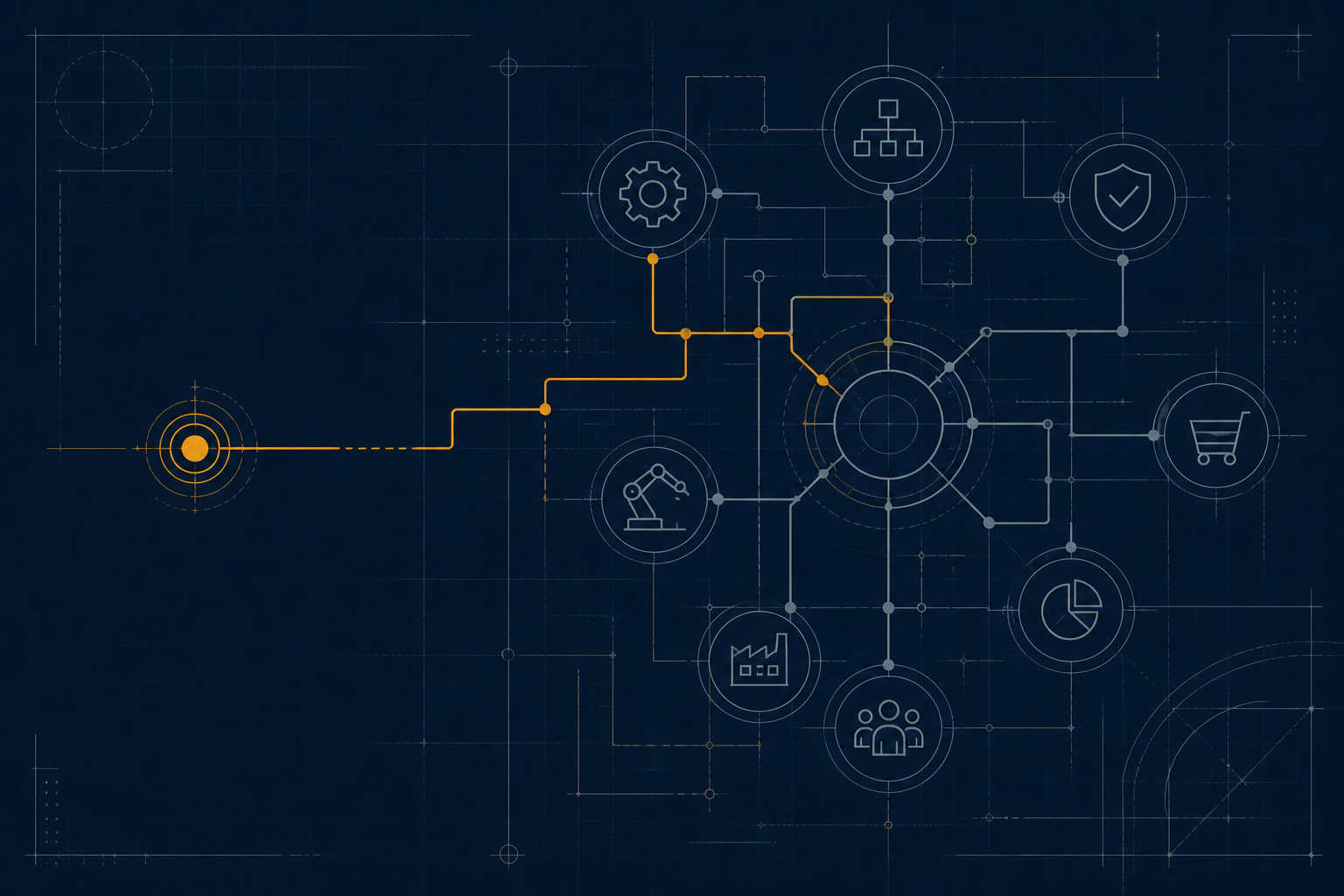
That range fits the operating reality of deep-tech and industrial purchases. A technical evaluator may care about performance and integration. An operator may care about reliability and maintainability. Quality may care about traceability. Procurement may care about supply, terms, and vendor risk. Finance and executive leadership may care about payback, exposure, and strategic fit. The names and sequence vary by program; the multi-perspective structure does not disappear because one person replies.
This changes the sales question. Instead of asking which persona to sequence next, ask what the current relationship can legitimately teach you about the committee: who owns the technical risk, which evidence is missing, what has changed since the last conversation, and who else needs to be able to explain the decision internally.
Long Cycles Create Memory Debt
When a technical sale lasts 12-24 months, the gap between conversations becomes part of the commercial problem.
A promising technical conversation from 18 months ago is not simply an old lead. It may contain a real design constraint, a qualification result, an integration concern, a program milestone, or an introduction to someone who was not yet involved. But after a long silence, the facts around the conversation have moved. The contact may have changed remit. The project may have changed phase. The original specification may no longer be the constraint. The relationship may be warmer, colder, or simply different.
Levin, Walter, and Murnighan found that people could obtain useful work-related knowledge from dormant contacts, with outcomes comparing favorably with current ties; reconnecting previously strong ties combined benefits associated with both strong and weak ties.6 The claim is not that an old technical contact will convert. The claim is that prior context can contain value that a current-status field cannot recover on its own.
Rondi, Levin, and De Massis add the boundary condition. Reconnection can fail when people do not refresh the tie and do not know whether they now see the relationship in the same way. Their research identifies remembering the shared episode, catching up, and perceiving the tie similarly as key elements.7 In industrial selling, that sequence becomes a practical memory protocol: retrieve the technical episode, learn what changed, then decide whether the relationship is ready for a next move.
- Last-known requirements are treated as current
- The contact is ranked by title or account fit
- The message asks the recipient to reconstruct the history
- A non-response is treated as a verdict
- The shared problem and evidence are retrieved first
- Change is stated cautiously, without invented certainty
- The next question is specific to the technical context
- The outcome updates the record for the next review
The operating implication is modest but important: do not let the CRM become a graveyard of names that once mattered. Preserve the minimum context that lets a future seller understand why the conversation existed, what was learned, what remains unverified, and what permission the relationship seems to carry. A record that can be reopened without pretending the past is present is a better asset than a larger list with no memory.
Trust Has to Travel Through the Committee
In technical procurement, persuasive language is only useful when another stakeholder can verify the claim.
Doney and Cannon's study of more than 200 purchasing managers developed and tested a model of how industrial buyers form trust in a supplier and its salesperson. Trust influenced anticipated future interaction, but after controlling for previous experience and supplier performance, it did not independently determine the current supplier selection decision.3 That distinction matters. Trust may open the door to continued evaluation; it does not replace performance evidence, technical fit, or internal consensus.
Zhang, Viswanathan, and Henke found in automotive and food-industry samples that purchasing agents' professional knowledge and ability to reach compromises shaped trust in the agent, while strategic communication affected trust in the buying firm.4 For a deep-tech seller, engineer-to-engineer credibility therefore has a practical shape: understand the problem precisely, communicate the implications clearly, and show where the evidence stops.
A current industrial buyer pulse points in the same direction, while requiring a clear sample boundary. In a Q1 2026 survey of 303 North American manufacturing decision-makers, independent third-party validation or certification was the most trusted early-stage proof type at 29%, followed by customer references from the industry at 20% and supplier technical documentation at 15%.5 This is a directional survey, not a universal market law. Its useful message is that supplier-authored material is one part of a proof system, not the whole system.
The practical test for every important claim is four questions: what exactly is being claimed; what artifact makes it checkable; which stakeholder can verify it; and under what conditions would the claim fail? The last question is often the most credible one. Engineers and operators do not need a perfect story. They need a story that survives contact with the system they have to own.
One Technical Contact Is a Bridge, Not a Buyer
A relevant technical relationship can reveal the committee faster than a blank-list sequence, but it cannot do the committee's work.
The most useful dormant contact is not necessarily the person who once showed the most enthusiasm. It is the person whose context makes the current problem more legible. They may know why the earlier evaluation stopped, which constraint was decisive, what the program is called internally, or which other functions entered the conversation later.
Reopening that relationship should aim first at orientation, not at a pitch. Ask what changed. Ask which part of the earlier problem is still real. Ask who would need to be comfortable before the work could proceed. If the contact cannot answer, that is useful information too. It tells the seller that the relationship is not yet a reliable bridge into the buying system.
The message is deliberately smaller than a sales sequence. It gives the recipient a way to correct the seller's memory, explain what changed, or decline. The system earns the next step by making the first step easy to evaluate.
Conferences Create High-Context Ties
A trade-show conversation becomes commercial memory only when the technical context survives the badge scan.
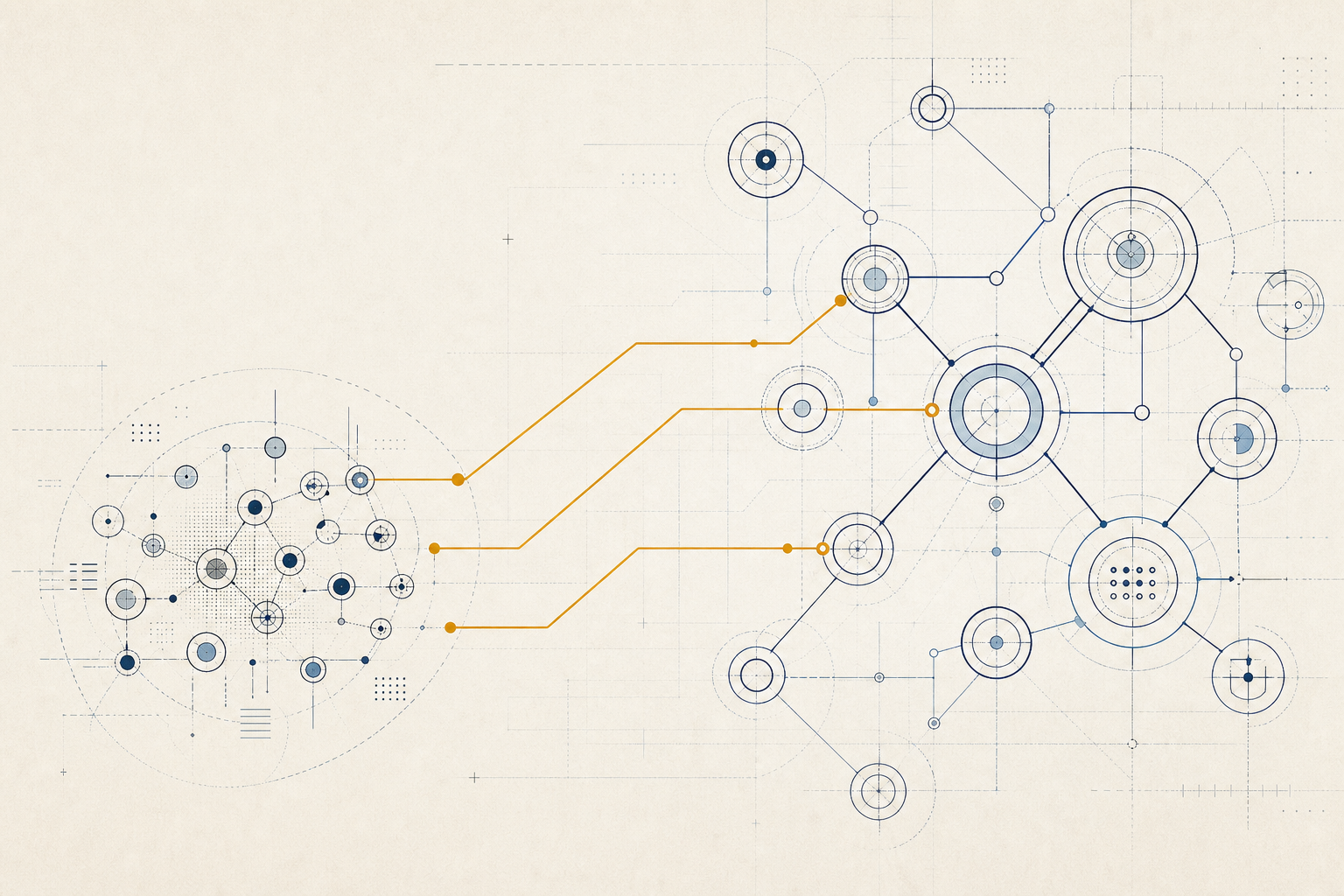
Deep-tech networks are built in places where the right technical people are already concentrated: conferences, trade shows, technical workshops, standards meetings, and customer visits. The advantage is not simply access to more contacts. It is the density of shared context: a specific talk, test method, design constraint, failure mode, production problem, or peer connection gives the first follow-up a reason to exist.
Research on B2B trade fairs supports this relational reading. A study of visitor-exhibitor interactions at an international trade fair found that socialization episodes, including information and social exchange, help generate relationship quality and development; information exchange was linked to trust, while social exchange was linked to satisfaction and commitment.8 Earlier industrial trade-show research, based on data from 27 shows, treated lead-generation efficiency as a performance measure and found that booth-personnel quality, relative spend, and show focus mattered.9
A 2021 study of 362 Portuguese SME exhibitors likewise found that sales-force proactivity influenced networking capability and sales performance, and that continuous participation contributed to performance.10 These studies do not prove that every event contact will become a sale. They do support a narrower conclusion: event presence, staff behavior, and follow-up are part of the relationship system, not separate from it.
Shared question
What technical problem, method, or constraint made the conversation worth remembering?
Peer context
Who else was mentioned, trusted, or already involved in the decision?
Next permission
What would be useful after the event: a note, proof, introduction, or pause?
The event should therefore end with a relationship record, not a lead count. Capture the technical episode while it is still vivid. Separate what was heard from what was inferred. Note the evidence that was requested and the people who might need to see it. Then decide whether to reopen, learn, map, or wait.
Reopen, Verify, Map, Record
The relationship loop is a light operating layer that makes long-cycle selling less dependent on individual memory.
A workable system does not need to turn every contact into a research project. It needs to preserve the few facts that change the next judgment. The loop is simple: retrieve context, verify what changed, map the relevant stakeholders, choose a permissioned next move, and record the new state.
For a founder-led or small sales team, the discipline is to keep the record compact. One line on the shared episode. One line on the change. One line on the proof or stakeholder gap. One line on the next permissible move. Anything more can be added when a live evaluation justifies it.
The relationship has a real episode and a plausible reason to speak now.
The evidence or current situation is not clear enough to make a claim.
The next step is to understand who else must accept the decision.
The outcome should make the next review easier than the last one.
Make Proof Shareable Before the Review
A technical claim travels when it can move between functions without losing its conditions.
Technical committees do not need the same proof in the same format. Engineering may need a test method and operating envelope. Quality may need traceability and a standard. Operations may need maintainability, training, and failure recovery. Procurement may need continuity, terms, and supply evidence. Executives may need a decision summary that does not distort the technical caveats.
The seller's job is to make the evidence portable. That does not mean flattening it into a slogan. It means preserving the claim, the artifact, the relevant peer, and the boundary condition so that another stakeholder can inspect the same underlying logic. The relationship record should therefore hold proof alongside memory. A warm contact without shareable evidence is still a fragile bridge.
This is where engineer-to-engineer trust becomes operational. A technical peer can correct a claim, explain a trade-off, or say that the stated use case is not comparable. That correction is valuable. It narrows the story, but it also makes the remaining story more credible. A seller who records the caveat is building a better bridge than a seller who records only the positive result.
The boundary is as important as the reference. Doney and Cannon's findings remind us that trust can shape future interaction without replacing prior experience or supplier performance in the current choice.3 A reference package should therefore accelerate inspection and consensus-building; it should not be used to skip technical validation.
Could another technical stakeholder verify the claim without taking the seller's confidence on trust?
The Honest Limit
Relationship memory is a useful layer for long-cycle sales. It is not a shortcut around evidence, timing, or judgment.
A committee range is not a target list. Gartner's figures describe variation, not a reason to chase a fixed number of people or assume every deal has the same structure.1
One technical contact is not a buyer. A useful relationship can reveal the map, but the committee still needs shared evidence and internal agreement.
Dormant-tie research is not a conversion guarantee. It supports a reason to refresh context, not a universal response rate, close rate, or sales-cycle reduction.67
Event presence is not relationship capital by itself. Trade-show research supports socialization, information exchange, networking, and lead-efficiency mechanisms; it does not make every scan a qualified opportunity.89
Systems do not make proof true. A clean record can surface a claim or a reference. Only technical validation, performance, and the buyer's own judgment can establish whether the claim holds.
Relationship memory is sales infrastructure for long-cycle markets.
When a technical conversation may resurface a year later, the asset is not the number of names in the database. It is the quality of the context that lets a seller reopen the right relationship, earn the next question, and help the buying committee see the same evidence.
- Keep technical relationships as compact, current records - not dormant names.
- Refresh the shared episode before asking for attention.
- Use one contact to map the committee, not to pretend the committee is simple.
- Make proof portable, peer-verifiable, and explicit about its limits.
- Record the next committee state after every meaningful interaction.
References
Endnotes are numbered in order of first appearance. The URLs below point to the publication, publisher, or research page used to verify the associated claim.
- Gartner. "Gartner Sales Survey Finds 74% of B2B Buyer Teams Demonstrate 'Unhealthy Conflict' During the Decision Process." May 7, 2025. https://www.gartner.com/en/newsroom/press-releases/2025-05-07-gartner-sales-survey-finds-74-percent-of-b2b-buyer-teams-demonstrate-unhealthy-conflict-during-the-decision-process
- Gartner. "Forming a Tech Buying Team? Who to Include; What to Focus On." Public Gartner guidance page, accessed August 2026. The indexed page describes six to seven members on average in tech buying teams. https://www.gartner.com/en/articles/help-your-tech-buying-team-work-more-effectively
- Doney, Patricia M., and Joseph P. Cannon. "An Examination of the Nature of Trust in Buyer-Seller Relationships." Journal of Marketing, 61(2), 1997. SAGE. https://journals.sagepub.com/doi/10.1177/002224299706100203
- Zhang, Chun, Sridhar Viswanathan, and John W. Henke. "The Boundary Spanning Capabilities of Purchasing Agents in Buyer-Supplier Trust Development." Journal of Operations Management, 29(4), 2011. DOI 10.1016/j.jom.2010.07.001. EBSCO abstract. https://openurl.ebsco.com/fulltext/gcd%3A59456768
- Kula Partners / InnovateMR. "Industrial Buyer Pulse Q1 2026." Survey of 303 North American manufacturing decision-makers, including engineering and technical buyers and procurement professionals. https://kulapartners.com/industrial-buyer-pulse/q1-2026/
- Levin, Daniel Z., Jorge Walter, and J. Keith Murnighan. "Dormant Ties: The Value Of Reconnecting." Organization Science, 22(4), 2010. INFORMS. https://pubsonline.informs.org/doi/abs/10.1287/orsc.1100.0576
- Rondi, Emanuela, Daniel Z. Levin, and Alfredo De Massis. "The Reconnection Process: Mobilizing the Social Capital of Dormant Ties." Organization Science, 35(2), 2024. INFORMS. https://pubsonline.informs.org/doi/abs/10.1287/orsc.2023.1685
- Bello, Daniel C., et al. "Applying a Relationship Marketing Perspective to B2B Trade Fairs: The Role of Socialization Episodes." Industrial Marketing Management, 44, 131-141, 2015. DOI 10.1016/j.indmarman.2014.10.010. https://www.sciencedirect.com/science/article/abs/pii/S0019850114001771
- Gopalakrishna, Srinath, and Jerome D. Williams. "Planning and Performance Assessment of Industrial Trade Shows: An Exploratory Study." International Journal of Research in Marketing, 9(3), 207-224, 1992. DOI 10.1016/0167-8116(92)90018-G. https://www.sciencedirect.com/science/article/pii/016781169290018G
- Silva, Pedro Mendonca, Victor Ferreira Moutinho, and Vera Teixeira Vale. "Examining the Relationship between Sales Force Proactiveness, Network Capability and Sales Performance: Evidence from International Trade Shows." Journal of Promotion Management, 28(5), 559-583, 2022. DOI 10.1080/10496491.2021.2009087. https://www.tandfonline.com/doi/abs/10.1080/10496491.2021.2009087